Thursday, March 10, 2011
Rug Rag For Area Rug & Carpet Style Inspiration
C.B.: Dave, tell me about Rug Rag. How did the company get started?
DD: My brother Matthew and I co-founded the website RugRag.com in 2007. Rug Rag is a resource for those interested in learning about Oriental rugs, antique rugs, and area rugs. As the tech man for Rug Rag, Matthew has brought many of our interactive consumer widgets to life. With my specialty in hand knotted rugs, I author the vast majority of information in our Rug archive and on-site tools, and serve as a rug consultant for our readers and their questions on a daily basis.
One of the first tools we created was the Rug Estimator Pro: an interactive sampler tool to help consumers understand some determining factors which go into the assessment of new and used hand knotted carpets. Estimates rendered from this tool are actually derived from several thousand individually assessed and valued carpets from around the world, many of them from notable auctions and inventories of nationally recognized rug importers.
C.B.: How did you become interested in rugs?
DD: My brother and I come from a long line of history in Persian rugs, so it was natural for me to learn about them at a very young age. Many memories of our younger years consist of being surrounded by carpets at our father's rug showroom in New York. However, it was not until I reached my late teens that a true appreciation for this artisan craft quickly turned into a hobby, and then passion.
C.B.: So your passion for rugs, a marvelously tactile and visual product, led you to the online world. How did that happen?
DD: In the late 90s, I truly pursued my interests in rugs and started researching the subject. As with any research project, there's a very steep learning curve at the beginning. With rugs, the mystique of a fine rug often either intrigues an individual to know more or overwhelms them to the point of confusion. Additionally, a great deal of misinformation on rugs remains rampant online. In many instances, less reputable sellers continue to exploit first time buyer misconceptions with "sale" prices.
We saw a need for a reliable resource for rug information and launched Rug Rag. It's a destination for consumers to learn with us or, using easy-to-use tools and resources we've made available on our website, they can learn on their own. One example of this is our Oriental rug forum, which continues to be an excellent resource and unadulterated center for interacting with specialists in the field of Oriental rugs.
I spend much of my time attending rug auctions - this picture of me was taken at a recent Sotheby's auction - browsing carpets online and consulting with consumers about their carpets.
C.B.: Absolutely fascinating!
And now, here is the article that David Dilmaghani from RugRag.com shares with us about area rug and carpet style inspiration.
--------------------
There is little question that many years ago your interior designer would say timeless designs and classic motifs of reds and blues were the bread and butter of their business. Now, the new wave of area rugs is of an entirely different breed.
Contextually, area rugs are among the easiest and most versatile decorative items within a space. By mere definition, area rugs are movable. By exploiting this inherent characteristic comes clear benefit of freedom. Without question, it is an exciting time to be a consumer in this market as the carpets now available are clearly
aligned with this spirit of decorative freedom.
Centuries ago, it was not uncommon to find what we now call area rugs to be throws and cover-alls above the floor. Carefully draped atop tables and chair-backs of the elite and well-to-do, Post 18th century, area rugs (traditionally hand-knotted rugs) were introduced back onto floors. Not only was this an aesthetic movement, but also in part, to serve their intended utility. Although rugs have been made for many, many centuries with varying techniques, weaving styles and textures, specifically now what is being presented to the market are extraordinarily progressive, and perhaps exponentially more integrative area rugs. Revivals, new weaving styles, materials, motifs, and even artist statements are bringing this somewhat traditional market to an entirely new era of floor covering. With the onslaught of the internet, almost any permutation of an area rug floor covering can spread like wildfire.
As an ode to classic and traditional and classic designs (and a bit of shabby chic) with a twist of color come worn semi-antique Turkish carpets. Exhibiting wear pattern and strong overtones of post-production coloring, Color reform, as ABC calls their line of transformed art, makes new headway by rejuvenating otherwise deemed retired carpets.
Reinventing relics with brilliant, upbeat colors for a dazzled effect is what these whimsical carpets are all about. What a statement in how simple and effective use of color can bring entirely new emphasis on decorative value. Plus, they can be green. Literally and figuratively.
Old design adapted and reintroduced into the marketplace is not limited to Color Reform carpets. Patchwork rugs, perhaps many years ago seen as the “seersucker” of area rugs, are exploding within the marketplace – so much so they’re being woven in one piece as opposed to being sewn together. These sometimes mismatched and haphazard integration of snippet designs completely transcends traditionalism in many ways.
With few exceptions, hand knotted rugs have largely been unbranded for the past century. Samad, a renown importer of fine hand knotted carpets, literally brings art back to the floor with a new twist.
Examples such as the Rex Ray collection provides duality - the prestige of a Samad rug with additional decorative appeal from the work of San Francisco based graphic designer, Rex Ray. Beautifully rendered and expressive designs adapted within the age-old technique of a hand knotted, piled carpet.
Traditional Flokati shag, not entirely dissimilar to the thick piled carpets of the 60s and 70s, seemed to have risen back into the marketplace as a high contender in the 90s and early 2000s. However, it seems many forgot how frightening these types can potentially be to keep clean, let alone vacuuming. Newer developments include a thick pelted felt pile with fat, nubby pile. This translates into an entirely different visual effect, but more so, a completely new consumer experience AND sensation while walking on these unique area rugs.
Timeless and classic motifs of yesteryear continue to have heavy momentum within the new market of area rugs. Although the new market in area rugs is constantly evolving, often incorporating bits and pieces of the old (literally). In a highly interactive world, with constant changes and developments continuing to propel the area rug market forward there is no question that rugs are the best investment of choice: Adaptable decorative items within interior design in many cases, providing a tangible experience in home decor harnessing your
room, whether on the wall, table, or of course the floors.
------------
Thank you, David, for sharing this marvelous area rug and carpet style inspiration! Rugs truly are the ultimate in design statements and these examples you've shared with us are marvelous!
I'd love to hear reactions to these area rug styles. Which is your favorite? How do you see using such design statements in your home?
You can reach David Dilmaghani on www.RugRag.com, on Facebook or via email at info@rugrag.com.
Posted by
CB Whittemore
at
5:31 PM
0
comments
Labels: C.B. Whittemore, Carpet around the world, carpet design inspiration, rugs
Wednesday, January 5, 2011
Around the World With Carpet.... At Airports
I was so excited about her find that I had to share it with you here.
First, it literally shows you carpet around the world from a multitude of airports.
Next, Carpets For Airports' author - George Pendle - has a delicious sense of humor that will have you in stitches.
Finally, I'm a big believer in carpet in airports - to absorb sound, add warmth and generally create a more welcoming environment there as well as in other public environments. These two posts - Pounding Las Vegas Pavements and A Foot's Perspective - Episode 4 - offer perspective on why.
Check out Bethany's post and visit Carpets For Airports. Will you? Then, let me know which is your favorite carpeted airport!
I can't wait to hear back from you.
Posted by
CB Whittemore
at
8:04 AM
0
comments
Labels: C.B. Whittemore, Carpet around the world, Carpet in the news
Monday, August 25, 2008
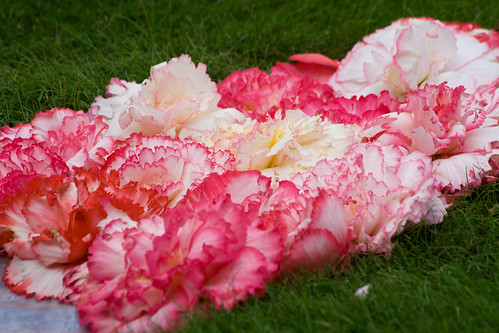
Brussels Flower Carpet 2008
Brussels' bi-annual Flower Carpet or Tapis de Fleurs took place last weekend with an official inauguration on August 14th. That celebration included a new and original music and light show [i.e., 'un spectacle son et lumiere'] directed by Grégoire Dune - live on the 14th, and rebroadcast on the 15th, 16th, and 17th at 10:00 PM, then rebroadcast at 10:00, 10:30 and 11:00 PM.
Solutia associates in our Louvain-La-Neuve location hoped to visit on behalf of The Carpetology Blog. Jacques Blomme said "I understand that this was absolutely superb but once again, almost impossible to get close unless you were ready to queue for hours. The terraces around were also totally crowded." However, Jacques forwarded me several links and resources to help bring this most recent creation to life for you. Merci, Jacques!
Something to remember for visitors who stay close to the Grand' Place: you can view the tapis de fleurs from the balcony of the Town Hall, every day, from 9:00 AM to 11:00 PM, and in 2008, you could also enjoy a special exhibit of prestigious floral themed carpets: "In precious threads, rare designs and colours, these masterpieces expand one’s knowledge and satisfy the curiosity of those who come to see the famous flower carpet. They are graciously deployed here by the internationally famous Maison Sadraee."
For you see, the 2008 Tapis de Fleurs motif featured floral and plant patterns. According to the official site of the Brussels' Flowercarpet, it was inspired by 18th century French patterns to create the world's largest Savonnerie carpet.
Image courtesy of Brussels' Flowercarpet.
The name 'Savonnerie' comes from the knotted-pile carpet factory established on the site of a former soap [i.e., savon] factory in 1627 by Pierre DuPont and Simon Lourdet, experts in carpets "in the manner of Turkey," with the royal granting of an 18 year monopoly from Louis XIII.
Per Brussels' Flowercarpet, "the designs of French carpets rapidly adopted a style where floral and plant patterns, mixed with royal and, inevitably, Christian symbols."
For example, did you know that the three petals of the fleur-de-lis represents the Holy Trinity? And the eight-pointed cross of the Templars symbolizes "the cosmic balance, the resurrection and the New Testament."Wikipedia's entry on Savonnerie states that "the Savonnerie style soon settled into more purely French designs, densely-massed flowers in bouquets against deep blue, black or deep brown grounds, within multiple borders" which you can see here from the two images of the carpet.
According to a volunteer involved in the project, the smaller elements of the 2008 overall design made the project more difficult as described in Belgians walk on flowers. The article also details the flowers used - begonias in a myriad of colors and purple dahlias - in addition to grass, tree bark and soil.

Some additional perspectives:
+ Arnaud posted a photo of the Brussels Flower Carpet 2008 on his Xarj Blog and Podcast. Imagine 700,000 begonias to create this ephemeral carpet masterpiece!
+ Brimming With Begonias, Thousands Of Flowers Carpet The Grand Place includes a magnificent slide show of nine photos of the 2008 tapis de fleurs.
+ YouTube features several videos on the 2008 tapis de fleurs de Bruxelles. This one [subscribers click on this link to view video of the Tapis de fleurs/Brussels Flower Carpet 2008] from abelisaurus2 gives you a taste of day and night time effects.
What a carpet chef-d'oeuvre!
If you weren't able to make it to Brussels, you have another opportunity to experience a flower carpet. This time in the United States and to be more precise at the Biltmore in North Carolina!
Inspired by the Brussels Flower Carpet and Frederick Law Olmstead, the Biltmore unveils new flower carpet on South Terrace and it takes place, for the first time ever, from August 29th through September 14th, 2008.
According to The Biltmore Estate Flower Carpet: A Living Tapestry, the Flower Carpet display is inspired by an ornate wrought iron grate inside The Biltmore House. The scale is smaller than that of the Tapis de Fleurs de Bruxelles with only 144,000 live plants used - coleus, pink and red begonias, ageratum and marigolds - for an 80 by 180 foot [i.e., 14,400 square feet] section of the South Terrace.
Nonetheless, it can only delight and inspire!
Technorati Tags: tapis de fleurs de Bruxelles Brussels flower carpet 2008 Biltmore flower carpet savonnerie carpet Del.icio.us Tags: tapis de fleurs de Bruxelles Brussels flower carpet 2008 Biltmore flower carpet savonnerie carpet
Posted by
CB Whittemore
at
5:49 PM
0
comments
Labels: C.B. Whittemore, Carpet around the world, carpet history, Carpet in the news
Sunday, August 24, 2008
Olympic Carpet Recap
The Carpetology Blog kicked off our Olympic celebration with Carpet at the Beijing Olympic Summer Games. But we couldn't let the Olympics end without recounting some of our very favorite moments - some of which involve carpet.
*The gymnastics events featured carpet the most prominently. We're so proud of the American women especially! Shawn Johnson won a gold medal in the balance beam competition, and Nastia Liukin won gold in the women's All Around competition.
*Michael Phelps has nothing to do with carpet, but we love him anyway. He's now the only person in the world who can claim eight gold medals from a single Olympic Games.
Photo of opening ceremony courtesy of www.xanga.com/tanguyen
*We were thrilled at the opening ceremony's carpet-like scroll. It turned out to be even more spectacular than we anticipated. The Telegraph in the UK described it like this:
"After 56 children, one from each of China's ethnic groups, brought the Chinese flag into the stadium, a 25m x 100m scroll unfurled to form a giant screen onto which images of China's 5,000-year history were projected. Dancers spread themselves across the bare scroll, making giant paintings as they went. Thousands of years of art, including cave paintings and one of China's most celebrated early paintings, the 12th century Song dynasty master work, A Thousand Li of Rivers and Mountains, were projected onto the scroll."
*The closing ceremonies are expected to include a cast of 7,000 people - still half of the size of the opening ceremonies. Again directed by Chinese filmmaker Zhang Yimou, they're set to air Sunday night on NBC. You never know - they may include carpet!Technorati Tags: 2008 Olympics, Beijing, Shawn Johnson, Nastia Liukin, Michael Phelps Del.icio.us Tags: 2008 Olympics, Beijing, Shawn Johnson, Nastia Liukin, Michael Phelps
Posted by
Elizabeth
at
9:45 PM
0
comments
Labels: Carpet around the world, Carpet in the news, Elizabeth
Monday, July 28, 2008
In Search of the World's Largest Carpet...
This past week, a Google Alert appeared in my inbox and immediately caught my eye: "Biggest Hand-Made Carpet in World" it read, proclaiming this achievement in the Turkish
Press, with a dateline from a little community called Nigde.
Of course I clicked on the link to read more. I realize that I'm easily distracted, but who can resist the world's biggest carpet?
The article stated that the alleged "Biggest Hand-Made Carpet" was created from two tons of wool acquired from 3,000 sheep and weighs 2,350 kilograms. And only six girls wove the entire 6.5m x 25.5m carpet (take a look at the carpet in the photo to the right).
Needless to say, I was impressed. Carpet weaving is a form of art, one that has been revered and practiced for centuries. I wanted to share this feat of skill with all of you, so I decided to do a little more research. My online searching came up with very little, unsurfacing the same article with nearly every link. But then I tried a few other search terms...
... And it turns out that the Biggest Hand-Made Carpet is not, in fact, the biggest after all.
This is: 
Created for a mosque in Tehran, the real largest hand woven carpet in the world is the size of a football field -- 60,546 square feet to be exact. Weavers in Iran's northwestern Khorasan Province used 38 tons of wool and cotton from Iran and New Zealand to create the carpet. Fun fact: it's made up of 2.2 billion knots.
The mosque is called Sheikh Zayed bin Sultan Al Nahyan mosque in Abu Dhabi, UAE. It is named after the founder of the United Arab Emirates, Zayed bin Sultan al-Nahyan. [A fascinating man and leader in his own right.]
According to the Immense Knowledge blog, "The carpet is called the Qasr al-Alam (The Palace of the World) and took Ali Khaliqi, an Iranian artist, eight months to design. It was woven by 1,200 women, aged between 15 and 60, over 16 months. Working in three villages in northeastern Iran, they tied 2.2 billion knots and used 38 tonnes of the finest moth proof wool and cotton. They were supervised by 50 men acting as technical experts."
The Immense Knowledge blog also states that the Palace of the World features traditional Persian designs like swirling vines and medallion centerpieces. In the photo above, the carpet rests in an open air prayer ground in Tehran.
I'm not sure carpet gets any better (or bigger) than that...
Technorati Tags: carpet Tehran Iran carpet world's largest carpet carpet in the news Del.icio.us Tags: carpet Tehran Iran carpet world's largest carpet carpet in the news
Posted by
Elizabeth
at
11:38 AM
0
comments
Labels: Carpet around the world, Carpet in the news, Elizabeth