Showing posts with label carpet history. Show all posts

Thursday, April 22, 2010

The Wear-Dated Brand & Memory Lane...

Wear-Dated 1968Time for a trip down memory lane for the Wear-Dated brand...

I mentioned in Meet C.B. Whittemore that I track mentions of Wear-Dated. Even though I no longer have any association with the brand, I really enjoy capturing these now elusive digital signs of Wear-Dated's earlier days - many of which remind me of my early days at then Monsanto's New York City offices located at 1460 Broadway when I worked on Wear-Dated in the Acrilan acrylic fiber division. I'd visit with my boss, Gary Petersen, and he would regale me with stories of Wear-Dated campaigns and programs...

In these latest mentions to have come through my inbox, do note the logo. The large "A" at the bottom refers to Monsanto's Acrilan acrylic fiber.

These two women in the image on the left appeared in a 1968 advertisement.

You'll love this site with page 16 from the 1971 Sears Catalog: Ladieswear... Be sure to check out each image and read the captions.

Note the third image of two women wearing Acrilan acrylic fiber knit dresses; the Wear-Dated logo barely peaks through at the bottom. Do you recognize the model on the left?

Wear-Dated 1964This next image of a man smiling in front of a schoolbus is from 1964. It was listed on eBay as "1964 Wear Dated Co Vintage Ad Smiling Man,School BUS" in January 2010. It's no longer available...

Wear-Dated stripesThe copy on this ad with bold striped knit shirts reads:

"Wear-Dated stripes are guaranteed. You have nothing to lose but your inhibitions.

These Wonderknit Lord Blair knit shirts are 100% Acrilan acrylic fiber, the richest of wash-and-wear. And they're Wear-Dated: unconditionally guaranteed for one year's normal wear. Replacement or refund by Chemstrand - read the Wear-Dated tag. See them in living color at fine stores everywhere. Long and short sleeves. Styles for boys, from $3.50. For men, from $5.00. Chemstrand, N.Y. 1, a Division of Monsanto Chemical Company, makes Acrilan acrylic fiber. The shirts are by Lord Blair.

Trust the Big Red "A." Buy when you see this tag."

In this next image, note that the Wear-Dated logo features a "C" [I assume for Chemstrand] rather than the "A" featured above. I came across this listing in January 2010, this time on Etsy where the garment is still available for purchase.

Wear-Dated 1960s
Here is a link to the full listing: VINTAGE 1960'S MOD SLEEVELESS TOP NWT SIZE by sewingmachinegirl. "When originally sold the top was Wear Dated- which guaranteed it for one years full normal wear! A wonderful genuine vintage top for this summer ! ..." It is made of nylon fiber.

My last find brings Wear-Dated back to carpet with two 1991 commercials for Wear-Dated carpet with stainblocker...

Per the description, they were aired on a local Los Angeles station KCOP-TV in February 1992.


1991 Wear-Dated Carpet With Stain Blocker Commercials
Uploaded by VSNHeats. - Classic TV and last night's shows, online.

That's it for now. I'm all caught up on my Wear-Dated brand historic mentions.

Until next time!

PS: For more on this subject, check out Signs Of Another Brand Trail: Wear Dated, Wear-Dated Brand Evolution and Creation Stories.

Friday, December 18, 2009

Spiders Create Magic Carpet Tapestry

Spider Created Magic Carpet Tapestry

Spider Silk Tapestry Brings Magic Carpet To Life

Madagascar Tradition Creates One-of-a-Kind Carpet Textile Marvel

No. I'm not spinning a yarn and telling tales.

A spider is, though. Or rather, a million female golden orb [aka Nephila madagascariensis] spiders have, creating a museum carpet artifact that brings back to life "an indigenous tradition on the island of Madagascar."

I learned about this from a 10/29/09 FastCompany.com article titled "Creepy, Crawly, Crafty: A Tapestry Woven by Eight-Legged Artists."

Given how immersed I've been lately with thoughts of creativity, innovation and inspiration [see BRITE 09: Innovating During Downturns & Surviving the Worst, Flooring eNewsletter #1 From Simple Marketing Now and Sources of Flooring Inspiration & Innovation], I was quite taken with the magnificent creativity that this spider-woven tapestry captured.

The richness of the saffron gold color [the reason behind the name 'golden orb'] and intricacy of design truly stop you in your tracks. I found it so beautiful, that I was reminded of how carpets were originally used: as tapestries. According to Wikipedia, the word 'carpet' originally referred to table linens and wall coverings. Not until the 18th century were carpets used on floors. Even then, they were rich in design and color [see Brussels Flower Carpet 2008 for perspective on patterns].

What's amazing from a visual perspective with this spider-created magic carpet is the opulence of the pattern and design, despite the monochromatic palette.

Furthermore, from a scientific perspective, this spider silk seems to be remarkably strong and filled with possibilities. Perhaps someday we'll have spider-silk textiles readily available around us as well as underfoot. Although, to put this magic carpet tapestry into perspective, it took four years and 60+ handlers to extract the spider silk and weave it into the exquisite patterns we see here.

This unique spider-silk textile is on display at the American Museum of Natural History which includes fascinating details of how the tapestry was created....

If there's a chance you're in NYC for the holidays, perhaps you'll visit the display. There's also a special exhibit titled Traveling The Silk Road [which includes a fun interactive website]. If you do go, would you share with us your impressions?

Related Post:
Magic Flying Carpets

Friday, January 16, 2009

In The News: Magic Carpets Exhibit, Paris Gibson Square Museum, Montana

Opening today, January 16 through February 14, 2009, you can travel to foreign lands on Magic Carpets. To start your journey, go to the Paris Gibson Square Museum of Art in Great Falls, Montana. Thanks to Pacific Recycling - which is headquartered in Great Falls - you can even get in for free through December of 2009!

[By the way, Pacific Recycling has a blog.]

I know a Great Falls in Virginia, but not this one in Montana and it sounds magnificent! Natural beauty second to none, with dramatic falls on the Missouri River, culture and a well organized town thanks to the vision of Paris Gibson - entrepreneur and politician - who arrived in 1882, envisioning possibilities for the site as the Electric City and a railroad hub.

The Paris Gibson Square Museum of Art sounds like a gem. Completed in 1896 out of sandstone, the building welcomed students for almost 80 years, until 1975. Two years later, volunteers from the community "renovated and reopened [the] historic building as Paris Gibson Square Museum of Art. Since that time, The Square has provided a dynamic program of exhibitions, classes, lectures, tours, and performances designed to nurture the region's creative spirit."

How cool!

Back to the Magic Carpets Exhibit....

According to the exhibit description and Paris Gibson Square Museum of Art opens two new exhibits in the GreatFallsTribune.com, Magic Carpets represents a "collection of carpets, runners, sofras and nomadic storage sacks was acquired by Terry Karson and Sara Mast, during their travels to Turkey in 2004 and 2007. The exhibition was organized by The Emerson Cultural Center, Bozeman, Montana and is traveling under the auspices of the Museum and Art Gallery Directors Association of Montana."

[Sofras are throws spread on the floor and used for dining akin to picnic blankets.]

It is also the final exhibit in a series of several fiber arts exhibitions on display at the museum during the fall and winter.

And, assuming you get this post in time, you can attend the Opening reception from 5:30 – 7:30pm tonight - Friday, January 16, 2009.

If you see the exhibit, would you let us know where the Magic Carpets took you and how it inspired you?

[Images courtesy of Paris Gibson Square Museum of Art.]

Technorati Tags: Del.icio.us Tags:

Wednesday, December 10, 2008

Understanding Carpet: Construction

Did you know that carpet as we know it today - i.e., primarily a tufted construction - is the product of a quintessentially American industry? I hadn't until I read Carpet Capital: The Rise of a New South Industry (Economy and Society in the Modern South). It describes how carpet construction shifted from being woven to tufted in the late 1950s and early 1960s, and from being manufactured in the North to the South.
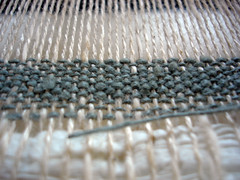
Today, although carpet is still either woven or tufted, over 95% of it is tufted.

A bit of history.

According to Wikipedia, the term 'carpet' also referred to "table and wall coverings as carpets were not commonly used on the floor in European interiors until the 18th century" [beautiful tapestries like The Unicorn Tapestries come to mind]. However, long before that the Turks - who have the longest carpet creation and use history - "protected themselves from the extremes of the cold weather by covering the floors, and sometimes walls and doorways, with carpets." Those carpets were all woven and, when they, and other Oriental carpets, began gracing European interiors in the 15th, 16th and 17th centuries, only appeared underfoot for royalty or statues of the Virgin Mary!

Luckily for all of us, that changed with trade routes opening up and the creation of a middle class of consumers...

2nd Scarf originally uploaded by Brittany No L.
Woven construction - as we describe it on the Wear-Dated website - has to do with the creation of carpet (or rugs) through a "weaving process on a loom where the lengthwise (warp) yarns and the widthwise (weft or filling) yarns are interlaced to form the fabric. In woven carpet, the face and back are formed at the same time by interweaving warp, weft and other yarns."

This is the same process used to weave sheets or apparel fabrics, including the scarf shown in the photo.

Traditional woven carpet styles include Axminster, Wilton - traditionally made in the U.K. - and velvet. In the U.S., Karastan is one of the largest carpet weavers.

[Do read this excellent description of Woven Carpet by Tom Cartmell, CFI Chairman of Industry Relations Committee.]

Image courtesy of the Carpet & Rug Institute
As mentioned above, the majority of carpet manufactured and sold in this country is tufted. Here's how Wear-Dated describes tufted construction.

For tufted carpet, "yarn gets tufted into a primary backing [a woven or non-woven fabric in which tufting needles insert pile yarn – that’s what creates the fuzzy side] which then gets glued or laminated to a secondary backing that reinforces and increases dimensional stability. That glue or latex coating also locks the fibers into place."

[In Carpet Construction Basics, Carpet Quality and Performance, Michael Hilton likens tufting to embroidery.]

Once manufactured, the carpet surface will have a 'fuzzy' look to it because the pile won't be perfectly level and neat. At that point, it will go into a "sheering machine which shaves off those variations to create a nice, smooth finished carpet."

The tufting construction process for carpet is an extremely versatile one in that many different styles of carpet are possible. I'll review those in the next installment of Understanding Carpet.

Other carpet construction resources:

Previous posts in this series include:
Understanding Carpet: Quality
Understanding Carpet: Benefits


Technorati Tags: Del.icio.us Tags:

Monday, November 17, 2008

The History and Science of Carpet

Okay, we admit it. Sometimes, people think carpet is boring. I know. It's shocking. But if you've read anything that we've ever written here at The Carpetology Blog, you know that we firmly and passionately disagree. We think carpet is fascinating, right down to its molecular structure. Which is what brings me here today. There's a whole science to Wear-Dated carpet that one just doesn't recognize when shopping in a typical flooring retail store. History helps put it into perspective.

In case you didn't realize, Solutia Inc. is Wear-Dated's parent company. Solutia, a spin-off of Monsanto (a name you probably recognize), is a performance materials and specialty chemicals company headquartered here in St. Louis. This is a fancy way of saying that the company uses science and technology to develop innovative solutions for customers. According to the company Web site, "Solutia creates performance materials that are used primarily in the automotive and architectural, transportation and industrial markets." One of these materials is Nylon 6,6.

Nylon? Like pantyhose, you ask? Actually, kind of.

Rayon, the first manmade fiber, was invented in the 1800s by Count Hilaire de Chardonnet, a French chemist who was trying to find a cheap substitute for silk. But the first truly synthetic fiber was patented by Dr. Wallace Hume Carothers, the “Father of Polymer Science,” in the early 1930s. He was part of an elite group of chemists hired by DuPont to explore the possibilities of polymer chemistry. This team also discovered polyester and neoprene, the first synthetic rubber.

In 1931 Carothers traveled to Washington DC to present a paper to the American Chemical Society. The paper was titled Fiber 6,6 – the first name of Nylon 6,6. Seven years later, the first commercial product made from Nylon 6,6 hit the market for consumers to buy - toothbrush bristles!

In 1939, nylon stockings were introduced at the World's Fair in New York (one of the largest of all time) and became a huge hit. They were far more affordable than silk, they conformed to the leg and they could be dyed unlimited colors. At this point in time, women actually fought over nylons, which they bought for $1 a pair. [Now, you'd have to fight me to make me wear a pair. Funny how times have changed, no?] Then during WWII, nylon became a luxury. It was rationed for military use and served as material for parachutes and artillery belts, a far cry from women's stockings. Talk about a multi-tasking material.

In 1953, after the war, Monsanto began manufacturing nylon as a way to diversify its business. Monsanto spun its chemical businesses off into Solutia in 1997, and Solutia still manufactures Nylon 6,6.

So that, in a nutshell, is the history of nylon. But the story doesn't end there...

There's an actual science to nylon that's especially important to us. You see, we specifically chose to manufacture Nylon 6,6 over other nylon chemistries for our carpet fiber which goes into residential as well as commercial carpet.


In terms of fiber manufacturing, Nylon begins at the oil well, where crude oil is used to make nylon intermediates. Out of nylon intermediates come hexamethylene diamine and adipic acid [also used as a food ingredient], two critical Nylon 6,6 building blocks that are transformed into nylon salt and then go into yarn manufacturing to emerge as either staple or bulked continued fiber [BCF] for carpet.

Our Pensacola plant makes primarily staple fibers, while our Greenwood, SC plan makes BCF fibers. [Check out our handy-dandy illustration for a more visual look at nylon manufacturing.]

Once manufactured, fiber goes to carpet mills to be spun into yarn, then tufted into carpet.

Did you know that the structure of the fiber itself is important to the final outcome of carpet made with Wear-Dated Nylon carpet fiber? And that Nylon 6,6 is better than nylon 6?

Here's why. Because its actual molecular structure is denser, Nylon 6,6 makes a harder and more resilient fiber, able to better withstand soil and dirt, prevent crushing, and offer more resistance and recovery. All reasons contributing to Nylon 6,6 being the carpet fiber most often specified by architects and designers for commercial installations. It's also why we refer to it as the durable fiber!

Below are a few terms to know when it comes to fiber technology...

Denier refers to the size of the fiber. There are two types - the size of the individual filament and the total size of a bundle of filaments (the fiber).
The Cross section is the shape of the individual filaments of the fiber (we're at a molecular level here). Many of our Wear-Dated and Ultron Nylon 6,6 carpet fibers feature a "mixed denier" cross section where we combine different cross sections to give our fiber the most natural-like luster in the marketplace, and get as close to wool as we can.

Our carpet fibers have a trilobal shape - a three-sided shape with a smooth surface and no grooves to attract soil. In fact, the trilobal shape itself actually aids in hiding soil [the first nylon fibers had a round cross-section and tended to draw attention to soil].

The luster of a fiber refers to the brightness of the fiber. Fiber manufacturers make a wide range of lusters ranging from bright (for residential applications), all the way to dull (for commercial applications).

Solutia manufactures Nylon 6,6 fiber in a variety of denier sizes. Carpet mills use denier as one of the tools to help them provide you, the consumer, with a wide array of color and styling options. This way, you can choose from carpet styles ranging from velvety soft cut pile to thick, nubby berbers.

Little did you know that when you're shopping for carpet, it's important to turn to science before you make a final decision.


Monday, August 25, 2008

Brussels Flower Carpet 2008

Tapis de fleurs (detail) [from 8/2008] originally uploaded by Sainz.

Brussels' bi-annual Flower Carpet or Tapis de Fleurs took place last weekend with an official inauguration on August 14th. That celebration included a new and original music and light show [i.e., 'un spectacle son et lumiere'] directed by Grégoire Dune - live on the 14th, and rebroadcast on the 15th, 16th, and 17th at 10:00 PM, then rebroadcast at 10:00, 10:30 and 11:00 PM.

Solutia associates in our Louvain-La-Neuve location hoped to visit on behalf of The Carpetology Blog. Jacques Blomme said "I understand that this was absolutely superb but once again, almost impossible to get close unless you were ready to queue for hours. The terraces around were also totally crowded." However, Jacques forwarded me several links and resources to help bring this most recent creation to life for you. Merci, Jacques!

Something to remember for visitors who stay close to the Grand' Place: you can view the tapis de fleurs from the balcony of the Town Hall, every day, from 9:00 AM to 11:00 PM, and in 2008, you could also enjoy a special exhibit of prestigious floral themed carpets: "In precious threads, rare designs and colours, these masterpieces expand one’s knowledge and satisfy the curiosity of those who come to see the famous flower carpet. They are graciously deployed here by the internationally famous Maison Sadraee."

For you see, the 2008 Tapis de Fleurs motif featured floral and plant patterns. According to the official site of the Brussels' Flowercarpet, it was inspired by 18th century French patterns to create the world's largest Savonnerie carpet.

Image courtesy of Brussels' Flowercarpet.
The name 'Savonnerie' comes from the knotted-pile carpet factory established on the site of a former soap [i.e., savon] factory in 1627 by Pierre DuPont and Simon Lourdet, experts in carpets "in the manner of Turkey," with the royal granting of an 18 year monopoly from Louis XIII.

Per Brussels' Flowercarpet, "the designs of French carpets rapidly adopted a style where floral and plant patterns, mixed with royal and, inevitably, Christian symbols."

For example, did you know that the three petals of the fleur-de-lis represents the Holy Trinity? And the eight-pointed cross of the Templars symbolizes "the cosmic balance, the resurrection and the New Testament."

Wikipedia's entry on Savonnerie states that "the Savonnerie style soon settled into more purely French designs, densely-massed flowers in bouquets against deep blue, black or deep brown grounds, within multiple borders" which you can see here from the two images of the carpet.

According to a volunteer involved in the project, the smaller elements of the 2008 overall design made the project more difficult as described in Belgians walk on flowers. The article also details the flowers used - begonias in a myriad of colors and purple dahlias - in addition to grass, tree bark and soil.

Image courtesy of Brussels' Flowercarpet.

Some additional perspectives:

+ Arnaud posted a photo of the Brussels Flower Carpet 2008 on his Xarj Blog and Podcast. Imagine 700,000 begonias to create this ephemeral carpet masterpiece!

+ Brimming With Begonias, Thousands Of Flowers Carpet The Grand Place includes a magnificent slide show of nine photos of the 2008 tapis de fleurs.

+ YouTube features several videos on the 2008 tapis de fleurs de Bruxelles. This one [subscribers click on this link to view video of the Tapis de fleurs/Brussels Flower Carpet 2008] from abelisaurus2 gives you a taste of day and night time effects.


What a carpet chef-d'oeuvre!

If you weren't able to make it to Brussels, you have another opportunity to experience a flower carpet. This time in the United States and to be more precise at the Biltmore in North Carolina!

Inspired by the Brussels Flower Carpet and Frederick Law Olmstead, the Biltmore unveils new flower carpet on South Terrace and it takes place, for the first time ever, from August 29th through September 14th, 2008.

According to The Biltmore Estate Flower Carpet: A Living Tapestry, the Flower Carpet display is inspired by an ornate wrought iron grate inside The Biltmore House. The scale is smaller than that of the Tapis de Fleurs de Bruxelles with only 144,000 live plants used - coleus, pink and red begonias, ageratum and marigolds - for an 80 by 180 foot [i.e., 14,400 square feet] section of the South Terrace.

Nonetheless, it can only delight and inspire!


Technorati Tags: Del.icio.us Tags:

Thursday, July 3, 2008

For July 4th: The History of the World (in terms of Carpet)

The Fourth of July conjures up the memory of hot summer nights, the soft flicker of lightning bugs and the intensity of the very best fireworks you'll see all year. It also gives us a little extra time to reflect on the fact that a little over 230 years ago, our young country was fighting desperately for its independence. And somehow, we did the unthinkable. We won.

From then on, the United States of America has been the land of opportunity. For better or worse, people arrive here to start new lives. They see the USA as a place where dreams come true and money is made, and whether this is accurate or not, many of us living here have excessively more than people in other parts of the world.

The trend of wealth and prosperity began early - some of our founding fathers had elaborate houses and extensive grounds. Often, their wealth included those extras the Average Joe couldn't afford - livestock, land, furniture, ... and carpet, of course! (You wondered how I'd work that in, didn't you?)

For decades, only the wealthiest families had carpet in their homes in America. Carpet reproducer J.R. Burrows' website suggests that carpet was a coveted possession. "In the Federal Period, when floorcoverings were prized and extremely costly, most wealthy American families had Brussels carpets in their best rooms." The site discusses both Wilton, a cut pile carpet, and Brussels, a loop pile, among others. Both were manufactured in Kidderminster, the carpet capital of Britain. In the 19th century, the wealthy tended to put the velvety Wilton in their very best rooms and Brussels in other areas of the house. "Brussels carpets were first woven in the early 18th century... Wilton carpets have the same structure as Brussels but the pile is cut open and sheared, producing a velvet-like quality. Although increased mechanization has equalized the pricing, in the 18th and 19th century the velvet pile of Wilton was roughly double the cost of Brussels."

Thomas Jefferson apparently enjoyed Brussels carpet in Monticello. You can actually see a list of the carpet found in many of his rooms here, on the Thomas Jefferson wiki. And at MountVernon.org, you can purchase reproductions of carpet that could very well have covered George Washington's floors.

But as you probably know, carpet has been around far longer than the young life of the United States. "The earliest surviving pile carpet in the world is called the "Pazyryk Carpet," dating from the 5th-4th century BCE," says Wikipedia. [You can see a photo of The Pazyryk Carpet at left.] It was excavated from the valley of Pazyryk and thought to have been made by the Iranian Scythians or the Persian Achaemenids. Historians and archaeologists can also trace carpet from Turkey, Persia, India, Pakistan and later, after the Crusades, even from Europe.

Originally, carpet was less of a luxury and more of a necessity. The Turks placed carpets on floors and over doorways to protect themselves from extreme cold temperatures. Then later - and still today - Muslims spread carpets on the floors of Mosques on which to worship.

Beginning in the 1790s, merchants began to bring carpet to the United States. At this point, carpet had become a luxury (as Thomas Jefferson could tell you). But today, all types and colors of carpet are found on floors in houses and trailers and mansions across the country. Carpet has become accessible and attainable for everyone, not just the wealthy. Strangely enough, carpet has even soared into the digital dimension - players in Second Life can purchase American Flag Flying Carpets [see image at right].

With Independence Day upon us, I'm not sure it gets more American than that.

Happy July 4th!


Technorati Tags: Del.icio.us Tags:

Related Posts Plugin for WordPress, Blogger...